
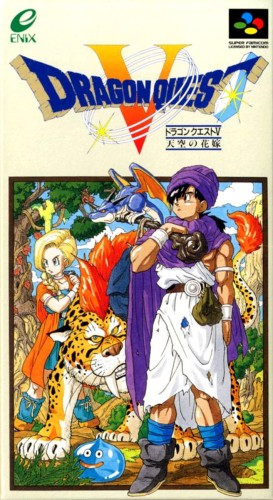

Dragon Quest V: Hand of the Heavenly Bride, originally released in Japan as Dragon Quest V: Tenkū no Hanayome, is a Japanese role-playing game developed by Chunsoft and published by Enix for the Super Famicom in 1992. It was the fifth main entry in the Dragon Quest series and the first developed specifically for Nintendo’s 16-bit console. The scenario and game design were created by Yuji Horii,
while Akira Toriyama provided the character designs and Koichi Sugiyama composed the soundtrack. Unlike the previous four games, the original version was not officially released in English; Western players received the first official localization through the Nintendo DS remake in 2009.
The game is distinguished by a story that follows its unnamed protagonist through several stages of his life. The adventure begins when he is a six-year-old boy travelling with his father, Pankraz, and continues through adolescence and adulthood. Rather than presenting another conventional tale of a predestined young hero, the narrative explores loss, captivity, friendship, marriage and parenthood. The player eventually chooses a wife for the protagonist, and his children later become important members of the party. This generational structure gives the story an unusually personal quality, allowing the player to observe both the hero and the game world changing over many years.
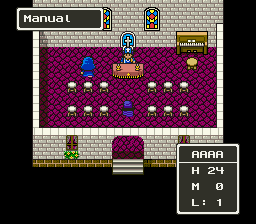
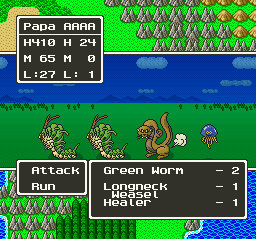
In terms of gameplay, Dragon Quest V retains the traditional structure of the series. Players explore towns, castles, caves and an overworld map, encounter enemies at random and fight them in turn-based battles viewed from a first-person perspective. Characters gain experience levels, learn spells and improve their equipment by purchasing or discovering new weapons and armour. The original Super Famicom version allows only three active party members, although additional companions can travel in a wagon. Battles are generally straightforward and comparatively fast, but the game still requires a considerable amount of combat and occasional experience grinding.
The most important addition to the established formula is the ability to recruit monsters. After certain battles, defeated creatures may ask to join the protagonist and can subsequently be trained, equipped and used like ordinary party members. Forty different monster species can be recruited in the original version, giving the player considerable freedom when assembling a party. The system anticipated the creature-collecting mechanics later associated with games such as Pokémon and became the foundation of the Dragon Quest Monsters spin-off series. Its usefulness is somewhat limited by the original game’s three-character battle party, especially after the protagonist’s human family members become available.
Visually, the game represented a clear advance over the Nintendo Entertainment System instalments, with larger and more detailed sprites, colourful environments and improved sound. Toriyama’s character and monster designs give the adventure the cheerful appearance traditionally associated with the series, even when the story deals with darker events. Sugiyama’s music ranges from lively travelling themes to more dramatic compositions, although the limited number of tracks can make some sections repetitive. The interface and combat system are deliberately conservative, and modern players may find the frequent random encounters, simple dungeons and menu-based controls dated. Nevertheless, the direct presentation keeps the emphasis on exploration and storytelling rather than mechanical complexity.
Dragon Quest V was commercially successful and received strong critical recognition in Japan. The game was later remade for the PlayStation 2 in 2004 and Nintendo DS in 2008, with expanded parties, additional recruitable monsters and updated graphics; mobile versions followed in 2014 and 2015. Despite its traditional mechanics, Dragon Quest V is commonly regarded as one of the strongest entries in the series, largely because of its ambitious generational narrative and emotionally engaging portrayal of a hero’s entire life.


Leave a Comment / Review: