
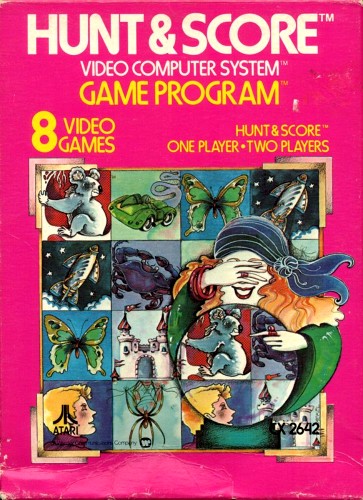
Hunt & Score is a memory-matching game developed and published by Atari for the Atari VCS in 1978. Programmed by Jim Huether, it was one of the system’s early adaptations of a traditional tabletop game and one of the relatively few Atari 2600 titles designed for the numerical Keyboard Controller. The game was later reissued by Atari as A Game of Concentration, while Sears distributed its own version under the title Memory Match.
Despite these different names, all versions are based on the familiar card game in which players attempt to remember the positions of matching pictures.
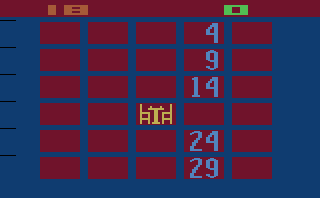
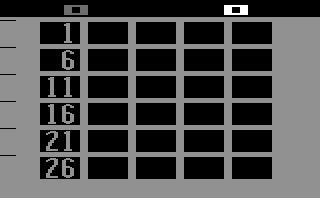
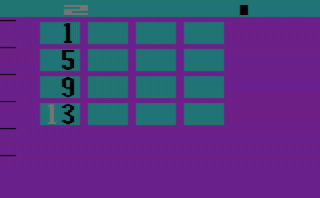
The playing field consists of numbered, face-down squares arranged either in a 4 × 4 grid of 16 cards or a 5 × 6 grid of 30 cards. On each turn, the player selects two squares, revealing the objects hidden beneath them. A matching pair disappears from the board, awards points and allows the same player to continue. If the pictures do not match, they are concealed again; in a two-player game, control then passes to the opponent. The objects include simple but recognizable pictures such as a butterfly, television, bell, flying saucer, castle, automobile and sailboat.
There are eight game variations combining three basic options: a 16- or 30-square board, one or two players, and the presence or absence of wild cards. A wild card automatically matches any ordinary object, making the board easier to clear. In the single-player modes, the objective is to remove every pair while making as few incorrect selections as possible. Two-player games instead award points for successful matches, with the winner being the player who achieves the higher score. The console’s difficulty switches provide a basic handicap system: a player using the B position receives two points for each match, while a player in the A position receives one.
The original cartridge requires one or two Atari Keyboard Controllers, sometimes also called Kid’s Controllers. Players enter a card number using the numerical keypad and confirm their choice with the # key. Since this specialized controller is not supported by the online emulator, the version presented here is a modified ROM in which the numerical controller has been replaced by joystick controls. Cards are selected by moving left or right with the joystick or corresponding arrow keys, and the choice is confirmed with the Fire button.
Visually, Hunt & Score is extremely simple even by Atari 2600 standards, but its brightly colored grid and small pictograms communicate all the information the game requires. The sound effects are similarly minimal, serving mainly to distinguish correct and incorrect guesses. Once two cards have been revealed, the game clearly indicates whether a successful match has been found before either removing the pair or returning both cards to their concealed state.
The game’s appeal consequently depends almost entirely on the enduring Concentration formula rather than audiovisual spectacle. The larger 30-card board provides a respectable memory challenge, while the competitive two-player mode remains the most entertaining way to play. Although Hunt & Score is a modest production, it is also an interesting example of Atari adapting a familiar family game to its early console hardware.

Leave a Comment / Review: