
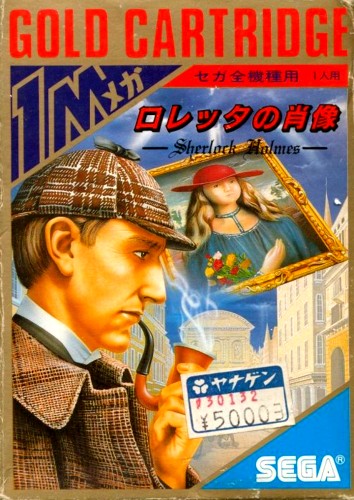
Loretta no Shōzō: Sherlock Holmes, also known in English as Loretta’s Portrait, is a graphic adventure game developed and published by Sega in Japan in 1987. Although it was released in packaging associated with the more advanced Sega Mark III, the game runs on SG-1000 hardware and is generally regarded as part of that system’s library.
Its 128 KB cartridge made it the largest and most extensive SG-1000 game ever released, standing apart from a catalogue otherwise dominated by comparatively simple arcade-style games.
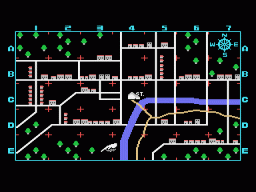
The player assumes the role of Sherlock Holmes, who is hired to recover a portrait of a woman named Loretta that has been stolen from an art gallery. The investigation is divided into three chapters and takes Holmes across Victorian London, represented by a map containing 34 accessible areas. Progress depends on visiting locations, questioning suspects, examining objects and collecting clues that gradually reveal new leads. Some areas also contain maze-like environments that must be explored separately from the main city map.
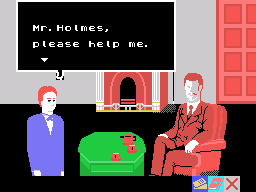
Gameplay combines menu-driven adventure mechanics with elements resembling a primitive point-and-click interface. Commands such as Look, Take, Ask, Examine and Use allow Holmes to interact with people and objects, while a second menu provides actions related to movement and entering buildings. In certain situations, the player can move a cursor directly over the illustrated scene to select a specific object or person. The system is ambitious for the hardware, although navigating its numerous menus can feel slow and some puzzles require very precise or obscure actions.
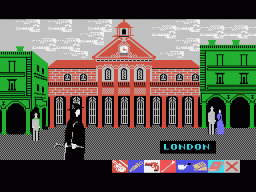
The game’s presentation is similarly impressive within the limitations of the SG-1000. Locations are depicted through detailed full-screen illustrations accompanied by extensive descriptive text and dialogue. Animation and sound are minimal, but the variety of settings and characters creates a convincing sense of travelling through London and conducting a substantial investigation. The large game world, lengthy narrative and unusually complex interaction system make Loretta no Shōzō one of the most technically remarkable productions created for Sega’s first home console.
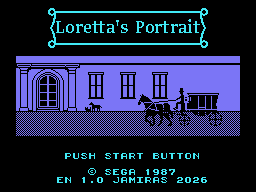
Because the original game was released exclusively in Japan, its extensive Japanese text made it largely inaccessible to international players for almost four decades. The first complete English fan translation, created by Jamiras, was released in March 2026 and translated the title screens, menus and dialogue. This version finally allows English-speaking players to experience the investigation without relying on a walkthrough. While its interface and puzzle design clearly reflect the conventions of early Japanese adventure games, Loretta no Shōzō remains a fascinating demonstration of how far developers could push the aging SG-1000 hardware.
Leave a Comment / Review: